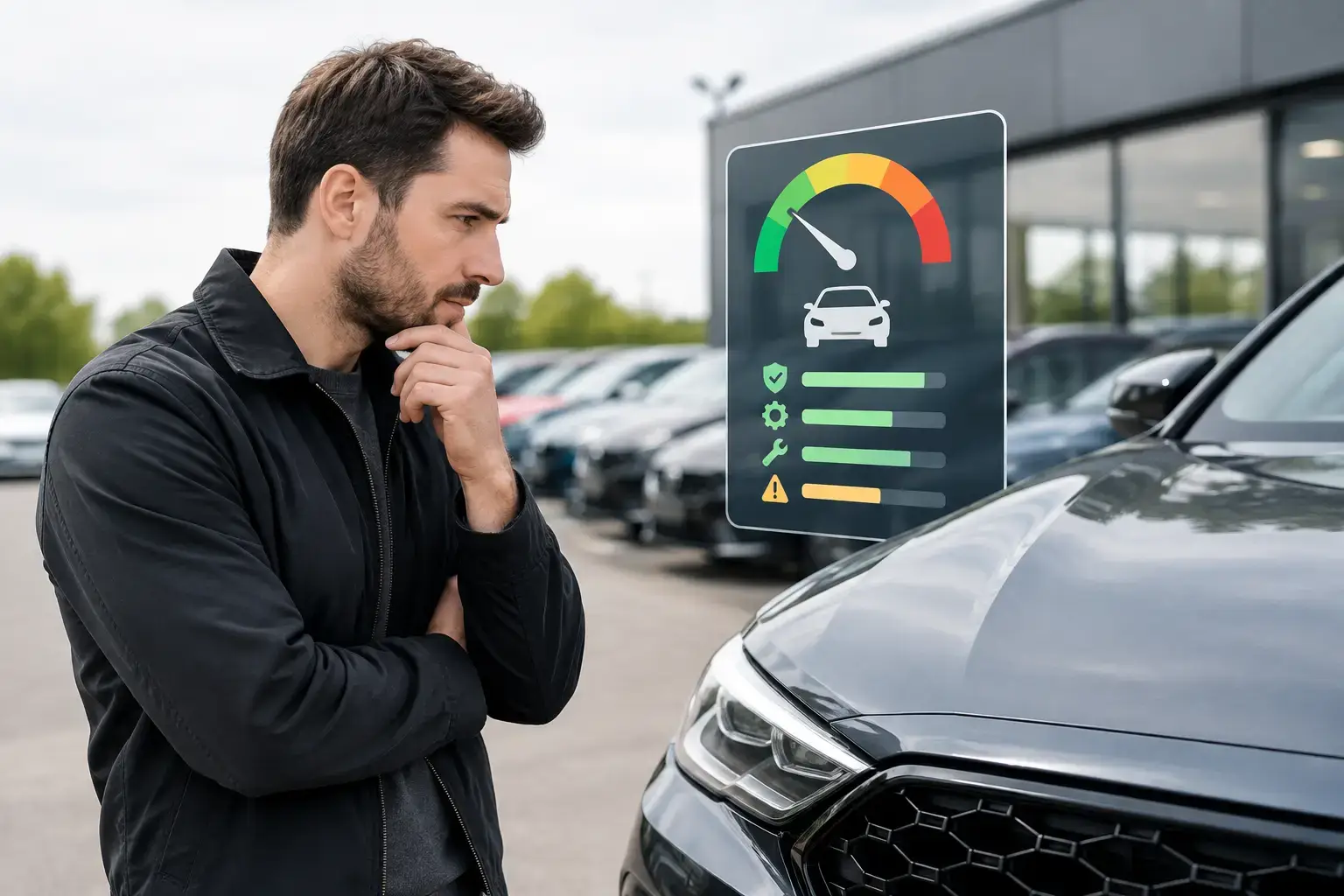
A cheap-looking used car can become expensive before its first service. A guide to vehicle risk scoring helps you separate a manageable imperfection from a warning that should stop the purchase, using the evidence available before money changes hands.
The 30-second answer
Vehicle risk scoring brings several checks into one practical buying view. It considers the vehicle’s recorded history, MOT and mileage pattern, price, seller answers and the things you can verify in person. The point is not to predict the future or declare a car perfect. It is to decide whether the evidence supports buying, negotiating harder, proceeding with caution or walking away.
A low score should not automatically mean a dishonest seller. A warning is not an accusation. Equally, a high score is not permission to skip a viewing, test drive or proper mechanical inspection. The best score explains why the vehicle has reached that position and what you should do next.
What a vehicle risk score should measure
A useful score is more than a count of red flags. One confirmed issue can matter more than several minor advisories. Outstanding finance, for example, may create a far more serious ownership risk than a single worn tyre advisory on an otherwise well-maintained car.
A buyer-focused assessment usually weighs five areas: identity and ownership risk, recorded damage or insurance history, mileage and MOT evidence, condition and maintenance signals, and price relative to the vehicle. The importance of each area depends on the car and the purchase.
A ten-year-old family hatchback with repeated brake, tyre and suspension advisories may still be a sensible buy at the right price, provided it has been repaired properly and drives well. The same pattern on a newer, expensive car with a premium asking price deserves more scrutiny. Risk scoring must reflect context, not treat every registration number alike.
Identity, finance and theft indicators
Start with whether the car is what the advert says it is and whether it can be sold without an unresolved claim. Finance information, theft markers, write-off records, number-plate history and ownership-related indicators can affect the decision before you even arrange to view.
These are not minor paperwork details. If a vehicle is recorded as stolen, or there is finance that has not been settled, pause the transaction and seek a clear resolution from the seller. Do not rely on a verbal assurance that it will be sorted after payment.
Check that the registration, VIN, make, model, colour and key details shown on the vehicle match the paperwork and advert. A mismatch needs an explanation. It may be innocent, but it is not something to ignore because the paintwork looks tidy.
Write-offs need context, not panic
An insurance write-off does not automatically make a car unsuitable. Its category, age, repair quality, documentation and price all matter. But it should change the way you assess value and inspection risk.
Ask when the damage occurred, what was repaired, whether invoices or photographs exist, and whether the seller has owned the car since the repair. A written-off vehicle may be worth considering if the story is consistent, repairs are credible and the price properly reflects its history. If the seller is vague, defensive or unable to evidence basic facts, the risk rises quickly.
MOT and mileage patterns
Official MOT history is valuable because it reveals recurring themes over time. One failed MOT is not necessarily alarming. A car can fail on bulbs, tyres or brakes and be repaired the same day. What matters is repetition, deterioration and whether the record makes sense alongside the mileage.
Look for advisories that return year after year, especially around corrosion, suspension wear, steering components, brakes, tyres, emissions or fluid leaks. Repeated advisories can indicate delayed maintenance. That does not mean the car is unsafe today, but it gives you a focused list for the viewing and a reason to budget carefully.
Mileage should rise in a believable sequence. Gaps, sudden drops or readings that do not fit the vehicle’s stated use need investigating. A mileage concern may be a recording error, an instrument replacement or something more serious. Until it is explained with evidence, treat it as a material uncertainty.
How to read a score without being misled
A number out of 100 is useful only when it is attached to evidence. Treat it as a prioritisation tool, not a substitute for judgement. The best reports show the issues behind the score, how strong the evidence is and where data was unavailable.
That final point matters. CarSussed does not turn an unknown into a green tick. If a connected source has not returned information, the correct interpretation is not “clear”. It is “not confirmed”. You may decide the remaining uncertainty is acceptable, but it should be a conscious decision.
A practical way to interpret a score is to ask three questions. First, are there any deal-stopping risks such as unresolved finance, theft concerns or an identity mismatch? Second, what is likely to cost money soon, based on MOT patterns, condition and missing maintenance evidence? Third, does the asking price leave enough room for those risks?
If the answer to the first question is yes, do not be distracted by a tempting price. If the answer to the second is yes but the issues are inspectable and priced in, negotiation may be appropriate. If key information is unavailable, decide whether you can verify it before committing.
Turn the evidence into a buying decision
Risk scoring becomes useful when it creates an action plan. “Caution” is not a verdict by itself. It should tell you what to ask, what to inspect and what would make you leave.
For a car with recurring tyre, brake and suspension advisories, inspect tyre age and tread, look for uneven wear, ask for recent invoices and pay attention to knocking, pulling or vibration on the test drive. For an emissions pattern, ask about servicing, warning lights and recent repair work. Never clear an engine warning light simply because the car appears to run smoothly for ten minutes.
When the history suggests a price risk, use it calmly. You do not need to accuse the seller of hiding anything. State the evidence, explain the cost or uncertainty it creates, and make an offer that reflects it. A credible seller should expect a buyer to consider MOT history, mileage, condition and provenance.
Questions worth asking before travelling
Before setting off, ask whether the seller has the V5C, how long they have owned the car, why they are selling, and whether there are service invoices and both keys. Ask directly about write-off history, outstanding finance and any recurring advisories. Then compare the answers with the advert and vehicle-history evidence.
If the seller avoids straightforward questions, changes the story, pressures you to pay a deposit, or refuses to let you see the vehicle at their stated address, treat that as a separate risk signal. A clean-looking report cannot compensate for an unsafe transaction.
Where scoring stops and physical checks begin
No remote report can tell you whether a clutch is slipping, a gearbox changes cleanly, the engine starts from cold or there is hidden corrosion underneath. History evidence helps you spend your time in the right places, but it cannot replace seeing the vehicle.
View the car in daylight where possible. Check the VIN and registration details, examine panel gaps and paint consistency, look for uneven tyre wear, test the electrics and take a proper test drive. For a higher-value purchase, a car with a complicated history, or anything that leaves you unsure, arrange an independent pre-purchase inspection.
Do not let sunk travel costs force a decision. Travelling two hours to see a car is frustrating; buying the wrong one because you have travelled two hours is worse.
Use risk scoring before you negotiate
The strongest time to assess risk is before you have emotionally decided that this is “the one”. Check the car while you can still walk away, then take the report and your questions to the viewing. If the evidence, seller explanation and physical condition line up, you can negotiate with confidence. If they do not, keep your money and keep looking.
The right used car is not necessarily the one with no recorded imperfections. It is the one whose history, condition, price and unanswered questions make sense for the risk you are willing to take.