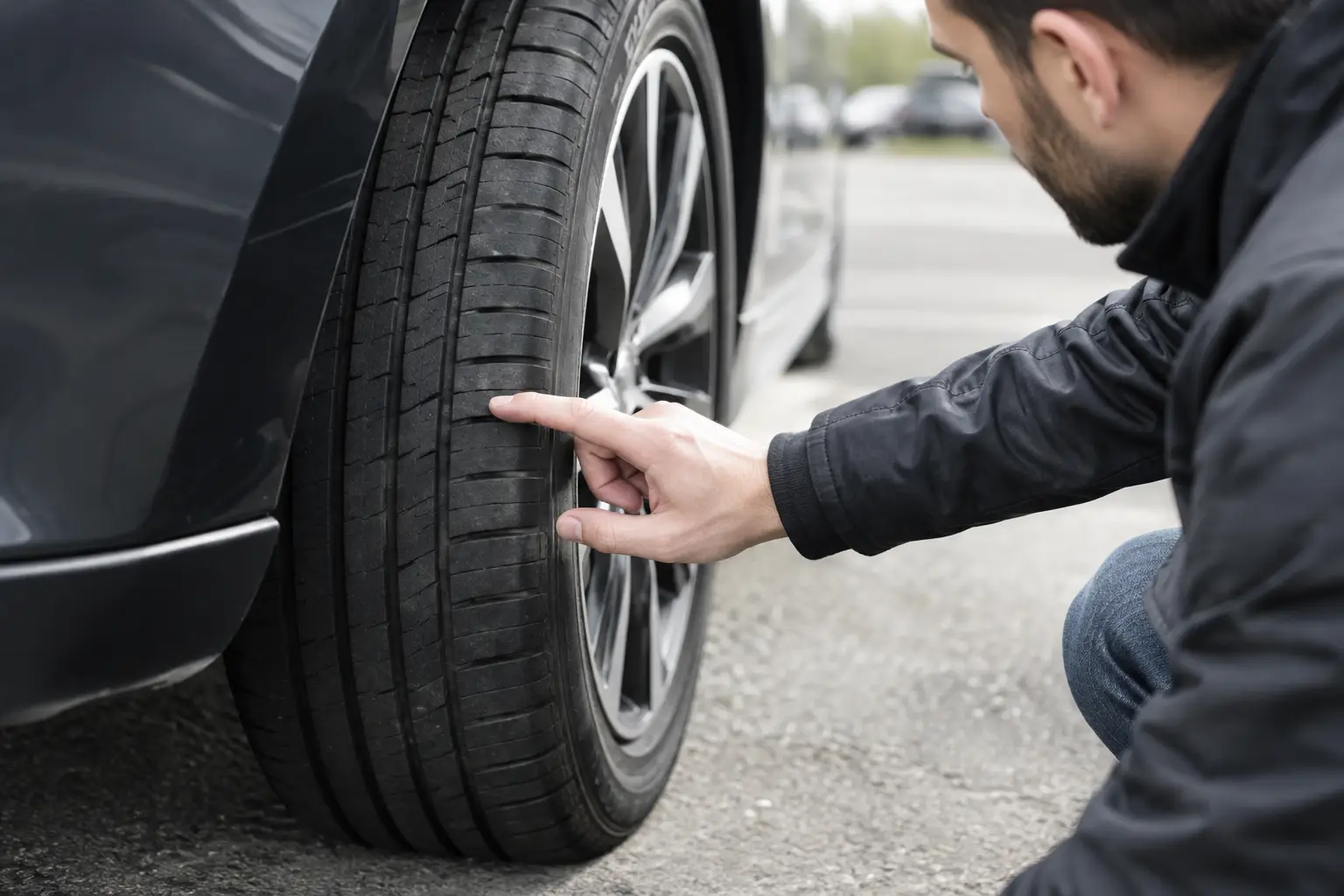
A set of tyres can turn a seemingly cheap used car into an immediate bill for several hundred pounds. Worse, uneven wear may point to a suspension, steering or alignment problem that new tyres alone will not cure. Take five minutes to assess tyre wear before purchase, ideally before you travel far or discuss a deposit.
30-second answer
Check all four tyres, not just the one nearest you. Look for enough legal tread, but do not stop there: uneven wear, cracks, bulges, cuts, ageing rubber, mismatched tyres and repeated MOT tyre advisories all change the picture.
A tyre at the legal minimum is not a bargain simply because it is technically road legal. In the UK, tyres must have at least 1.6mm of tread across the central three-quarters of the tread, around the full circumference. For a used-car buyer, closer to 3mm is a more useful threshold for planning. Below that, wet-weather performance declines and replacement will be due sooner rather than later.
If one tyre looks poor, inspect the others carefully. A warning is not an accusation, but it is a reason to ask questions, reduce your offer or pause the purchase until the cause is clear.
Start with tread depth, then inspect the pattern
A proper tread-depth gauge is inexpensive and gives the clearest answer. Measure each tyre in several places across its width: the inner edge, centre and outer edge. Do this around more than one part of the tyre, because wear can vary around the circumference.
The wear bars moulded into the tread are also useful. These small raised sections sit in the main grooves. When the surrounding tread is level with them, the tyre is at about 1.6mm and at its legal limit. They tell you when a tyre is worn out, not whether it has worthwhile life remaining.
Do not accept a seller’s description of “loads of tread” without looking. If you cannot measure it during a viewing, take clear close-up photographs and ask for a written tread-depth reading from a garage. A seller who has nothing to hide should understand why you are checking.
What uneven tyre wear can mean
Even wear across the tyre is the encouraging result. Wear concentrated in one area needs an explanation.
Outer-edge wear often suggests regular under-inflation, hard cornering or poor wheel alignment. Centre wear can be associated with over-inflation. Wear on one shoulder, particularly the inner edge that is harder to see when the wheel is fitted, may indicate alignment issues or worn suspension components.
Cupping or scalloped dips around the tread can point towards worn dampers, wheel imbalance or suspension wear. A patch of wear in one place may follow heavy braking, a skid or a tyre that has been driven with a fault. These are not remote diagnosis results. They are inspection priorities. Ask for the car to be checked by a qualified mechanic before you commit if the pattern is pronounced or appears on more than one tyre.
Check the sidewalls, not only the part touching the road
Turn the steering to full lock, with the engine running only if needed and safe to do so, to get a better view of the front tyres. Use your phone torch to inspect the inner and outer sidewalls. For the rear tyres, crouch down and look behind the wheel where practical.
Walk away, or at minimum stop the purchase until an expert has inspected the car, if you find a bulge, blister, exposed cords, a deep cut or a split sidewall. A bulge can mean internal tyre damage. It is not a cosmetic mark and should not be dismissed as normal wear.
Also look for cracking in the rubber, especially around the sidewall and between tread blocks. Fine surface cracking does not always mean a tyre is immediately unsafe, but widespread cracking suggests age, exposure or neglect. Treat it as a likely replacement cost and consider whether the car has been standing for long periods.
Check for nails, screws and repairs too. A professionally repaired puncture may be acceptable, depending on its position and condition. A screw still embedded in the tyre, a repair close to the sidewall or evidence of repeated punctures deserves closer scrutiny.
Check tyre age and matching before you agree a price
Tread depth alone does not tell you whether a tyre is a sensible prospect. Find the four-digit date code on the sidewall, usually at the end of the tyre’s DOT marking. For example, 2323 means the tyre was made in week 23 of 2023.
Older tyres can look healthy if the car has covered low mileage, but rubber hardens with time. That can reduce grip, particularly in wet or cold conditions. There is no single age at which every tyre must be replaced, so assess the date code alongside cracking, tread condition, storage history and the car’s use.
Then check whether the tyres match across each axle. Ideally, a car should have matching tyres of a reputable make, similar condition and similar tread depth on the front pair and rear pair. A mixture of brands is not automatically a deal-breaker, but four unrelated budget tyres can suggest cost-cutting maintenance. One premium tyre paired with a very worn unknown-brand tyre is not a balanced set-up.
Confirm that the tyre size matches the car’s approved specification. The size, load rating and speed rating are printed on the sidewall. If you are unsure what should be fitted, compare all four tyres and check the vehicle handbook or manufacturer information. Incorrect or unsuitable tyres can affect handling, insurance and MOT compliance.
Use the MOT history to see the pattern
The tyre condition you see today is only one snapshot. Official MOT history may reveal repeated advisories for worn tyres, damaged tyres, uneven wear or tyre condition. One advisory followed by replacement is ordinary maintenance. The same tyre-related concern appearing over successive years may show that the owner delayed repairs or that an underlying alignment or suspension issue has not been resolved.
Mileage readings matter here too. If the car has covered very few miles since its last MOT but the tyres now look heavily worn, ask why. Equally, a car that has covered substantial mileage since an MOT with tyre advisories may simply be due a full set now.
Do not assume the absence of an MOT advisory means the tyres are good. MOT testing is not a full tyre-life forecast, and tyres may have been changed since the test. It is evidence, not a green tick.
Turn what you find into a buying decision
Price tyres as a set, not as a single replacement, where wear or matching makes that sensible. The cost depends on wheel size and tyre type. A small hatchback on common tyres may be relatively affordable; larger wheels, run-flat tyres or premium-rated tyres can make a full replacement far more expensive.
If the tyres are approaching 3mm but otherwise even, undamaged and sensibly matched, negotiate based on a foreseeable cost. If two tyres are worn unevenly, ask the seller what caused it, whether wheel alignment has been checked and whether there are invoices for suspension work. If they offer to fit replacements, agree the tyre make, specification and work in writing before money changes hands.
A useful seller question is: “Can you explain why this tyre is worn more on the inner edge, and has the alignment or suspension been inspected?” The answer matters, but so does the evidence behind it. Receipts and a recent alignment print-out carry more weight than reassurance.
For a car that is otherwise right, tyres can be a straightforward negotiating point. For a car with damaged tyres, unexplained uneven wear, poor MOT history and a seller who brushes it off, the safer decision may be to walk away. Your next car should not begin with a gamble on the only parts keeping it in contact with the road.