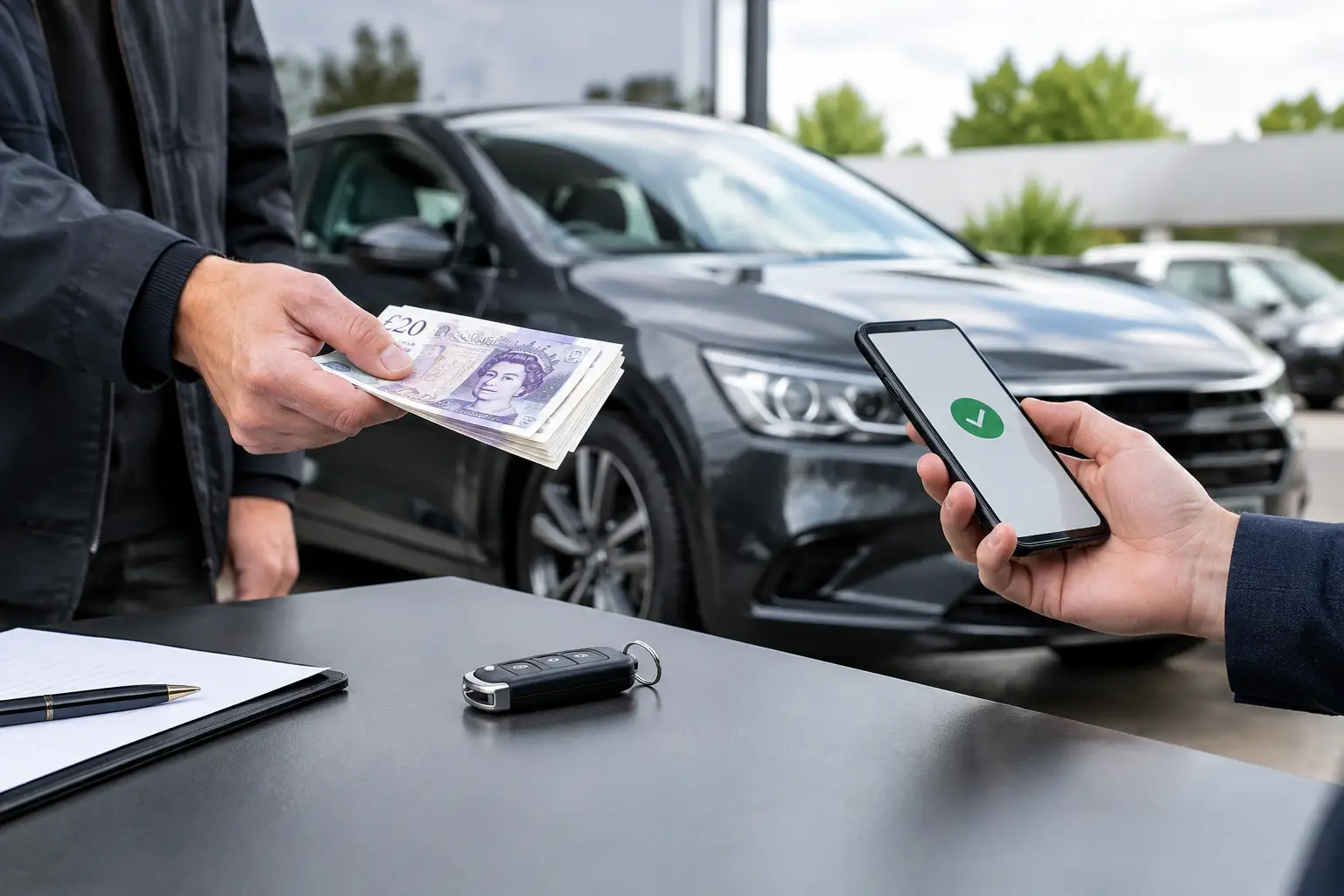
A used-car handover can become expensive in minutes. In the cash payment versus bank transfer decision, the safest option is usually the one that gives you a clear record, lets you verify the recipient, and happens only after the car and seller have been checked properly.
For most buyers, that means a bank transfer made at collection is more practical than carrying a large amount of cash. But it is not automatically safe. A transfer sent to a fraudster is still a transfer sent, and a convincing seller or advert does not prove the vehicle is theirs to sell.
30-second answer
Prefer a bank transfer at collection, after you have inspected the car, checked the seller’s identity and address, confirmed the account name, and agreed the paperwork. It creates a time-stamped payment trail and avoids the personal-security risk of carrying thousands of pounds in notes.
Use cash only if you can verify the notes, obtain a detailed signed receipt, and manage the collection safely. Cash can be appropriate for a low-value car, particularly where both parties want immediate settlement, but it leaves less of an audit trail and introduces counterfeit and theft risks.
Whichever method you choose, do not treat payment as the first step. It is the final step after the vehicle history, documents, identity, condition and price all make sense.
Cash payment versus bank transfer: what changes?
The main difference is evidence. A bank transfer normally shows the date, time, amount and recipient account. That is useful if there is later confusion about whether payment was made, what was paid, or which person received it. Ask the seller to confirm the account holder name displayed by your bank before sending money. If their explanation for a mismatch is vague, stop.
Cash is immediate, which some private sellers prefer. Once counted and accepted, there is no waiting for a bank to process it. Yet it is harder to prove exactly what happened unless both parties sign a proper receipt. A receipt helps, but it does not prove the car was legally theirs, mechanically sound or free from outstanding finance.
Neither payment method fixes a bad purchase. A warning is not an accusation, but it is a reason to slow down and ask better questions before money changes hands.
Why bank transfer is usually the better choice
A Faster Payment can be convenient when you are standing with the seller, the car and the documents in front of you. You can complete the transfer after a test drive and after checking the vehicle identification number matches the V5C and the car itself. The seller can see the payment arrive before releasing the keys.
That shared confirmation matters. There is less argument over whether the cash was counted correctly, whether a note was genuine, or whether a payment was received. You also avoid travelling with a substantial amount of money, which can put both buyer and seller at risk.
A transfer record can support your own records too. Use a sensible reference, such as the registration number and “car purchase”. Keep the advert, messages, agreed price, receipt, V5C details and any service paperwork together. If you later need to explain the transaction to your bank, insurer or a dispute process, a tidy paper trail is valuable.
There are limits. A bank transfer is not an escrow service and does not provide a physical inspection. It does not make an unknown history item safe, and it does not give you a right to reverse the payment simply because you change your mind. Once authorised, recovering money can be difficult, especially if you have paid a fraudster.
The risks to manage with a bank transfer
The most serious risk is sending money before you have control of the situation. Fraudsters may claim they are abroad, say another buyer is waiting, or ask for a holding deposit to remove an advert. Pressure is part of the warning sign. Do not let a supposedly popular car turn a sensible check into a rushed payment.
At collection, make the transfer only when you are satisfied that the person in front of you is the person you have been dealing with, or they can credibly explain their relationship to the registered keeper. Check photo identification where appropriate and compare the name and address with the V5C. A V5C alone is not proof of ownership, but inconsistencies deserve an explanation.
Be cautious with changed bank details. If a seller sends new payment information shortly before collection, verify it by speaking to them using the number you already have, not a contact detail supplied in a sudden message. Check the payee name shown by your bank’s confirmation-of-payee process where available. Do not bypass an alert just because the seller says their partner, business or relative uses the account.
Never hand over a transfer confirmation screen as if it proves funds have arrived. Wait for the seller to confirm cleared receipt in their own banking app, then complete the signed receipt and key handover.
When cash can still make sense
Cash is not inherently suspicious. Some genuine private sellers prefer it because they can see and count the money immediately. For a modestly priced vehicle, a cash transaction may feel straightforward, provided the meeting is safe and the seller is comfortable accepting it.
The practical problems increase with the amount. Counting a large sum at the roadside is awkward. Carrying it exposes you to theft. Sellers may worry about forged notes, while buyers may feel pressured to leave cash before they have finished their checks. A bank branch or other secure, public location may reduce some risk, but it does not replace due diligence on the vehicle.
If you pay cash, take a written receipt before leaving. It should record the date and time, registration number, vehicle identification number, make and model, agreed price, payment method, mileage shown, and the full names and addresses of buyer and seller. Both parties should sign it. Photograph the receipt and retain the advert and messages.
Do not rely on a handwritten note alone where the seller cannot show a convincing connection to the car. The same applies if the vehicle is being sold from a lay-by, a supermarket car park, or an address that does not match the story you have been given. A convenient meeting place can be reasonable, but it removes useful context.
Do not pay a deposit just to secure the car
A deposit should be the exception, not the price of being allowed to view a car. If you decide one is necessary, keep it small, use a traceable payment method, and confirm in writing whether it is refundable and under what conditions. For example, you may agree that it is returned if the car is materially different from the advert or a key history concern emerges.
Never send a deposit because a seller claims several buyers are on their way. Do not pay one to reserve a car you have not seen simply because the price appears unusually attractive. A bargain that requires instant payment is often asking you to ignore the very checks that would protect you.
A safer payment sequence at collection
Start by viewing the car in daylight where possible and give yourself time. Check the registration, VIN and mileage against the paperwork and the vehicle. Review service records, inspect for the issues suggested by the MOT history, and take a proper test drive if insured and permitted.
Then confirm the seller’s identity and their link to the vehicle. Ask direct questions: why are they selling, how long have they owned it, what work has recently been done, and is there anything they would want a careful buyer to know? Straight answers do not guarantee a good car, but evasive ones tell you something.
Before agreeing payment, make sure the price reflects what you have found. A history check can highlight finance, theft, write-off, ownership, plate and mileage indicators, but evidence coverage matters. If information has not been returned, it remains unknown rather than clear. CarSussed is designed to turn those findings, MOT patterns and valuation context into a practical buying decision before you travel or negotiate.
Only then should you pay. Complete the receipt, receive all keys and documents, and ensure the registered-keeper process is dealt with correctly. Tax does not transfer with the car, so arrange your own cover and tax before driving away.
When to walk away
Walk away if the seller pushes for payment before inspection, cannot explain name or address discrepancies, wants money sent to an unrelated account, refuses a receipt, or tries to prevent you from checking the car properly. Also pause if the VIN, mileage, paperwork or vehicle story does not line up.
Losing a chance to buy one car is frustrating. Paying quickly for the wrong one is usually far more costly. The right seller will understand why a careful buyer wants the evidence, the paperwork and the payment process to add up.