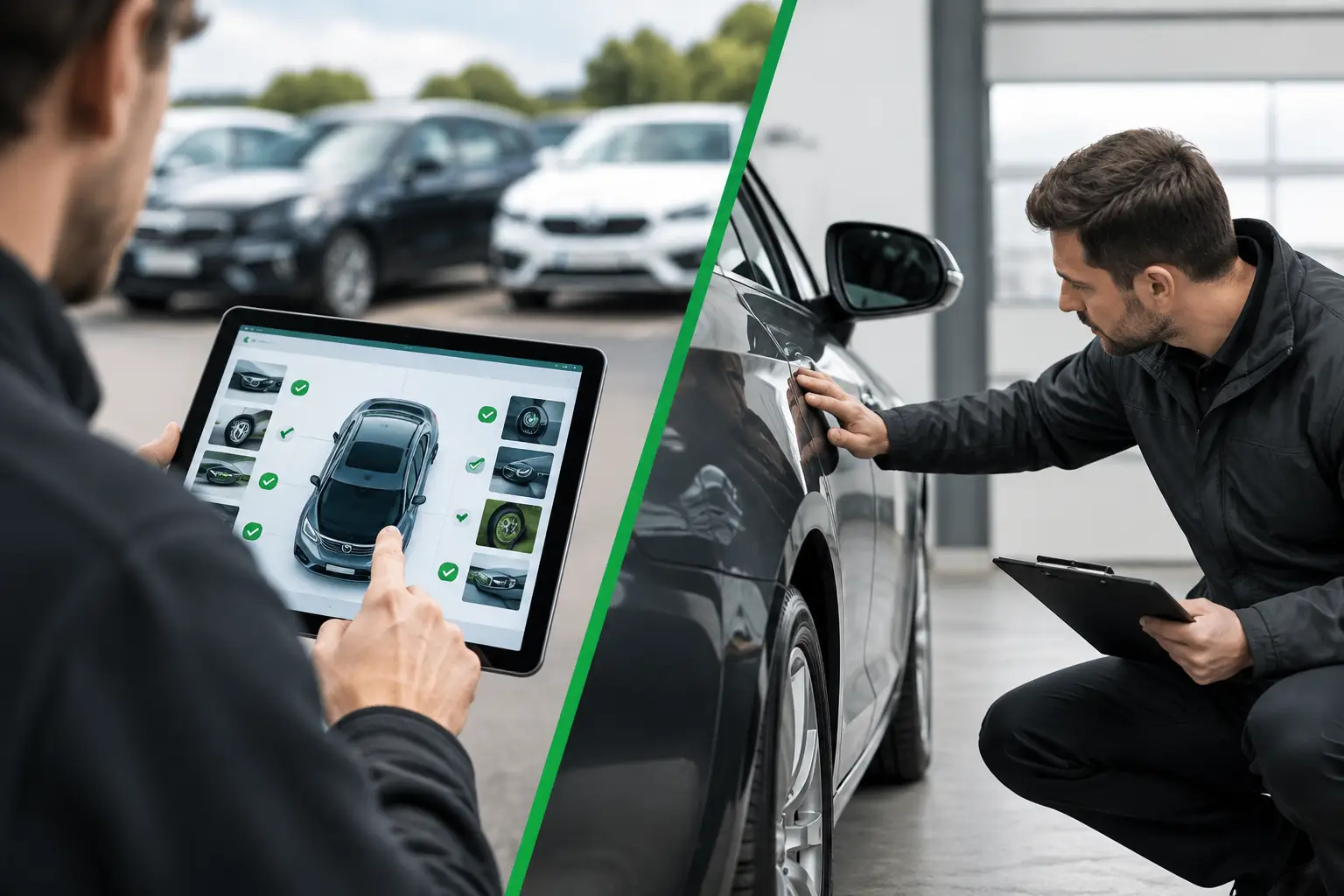
A vehicle check versus physical inspection is not an either-or choice when you are buying used. One looks for problems in the car’s recorded past; the other looks for faults, wear and warning signs in the vehicle in front of you. Skip either stage and you may be making a decision with a major blind spot.
The 30-second answer
Run a vehicle-history check before you travel, before you pay a deposit and certainly before money changes hands. It can flag recorded finance, theft status, write-off history, mileage concerns, plate changes and patterns in MOT results that deserve an explanation.
Then inspect and test-drive the actual car. A history check cannot hear a noisy timing chain, feel a slipping clutch or spot poor-quality accident repairs. Equally, a clean-looking car cannot tell you whether it carries recorded finance or whether its mileage history makes sense.
The sensible approach is simple: check the evidence first, then inspect the car with the right questions in hand.
Vehicle check versus physical inspection: what each can tell you
A vehicle check uses the registration to bring together available recorded information about that specific car. This is especially useful at the advert stage, when you are deciding whether a journey is worthwhile and whether the asking price is realistic.
Depending on source availability, the information may include recorded finance, theft markers, insurance write-off records, MOT history, mileage readings, ownership indicators and number-plate history. It can also help you compare the advertised description with recorded facts. If an advert says “never damaged”, but a write-off record appears, that is a serious issue to resolve before you view it.
A physical inspection is about current condition. It looks at bodywork, tyres, lights, fluid levels, warning lamps, service evidence, cabin wear, panel gaps and the way the car starts, drives, brakes and changes gear. It may reveal neglected maintenance, corrosion, leaks, smoke, electrical faults or signs that a repair was not completed to a good standard.
Neither is a substitute for the other. A warning is not an accusation, and an apparently tidy car is not proof that its history is clear.
What a vehicle check cannot prove
History data is valuable because it can reveal issues that are impossible to judge from a driveway viewing. But it is not a remote mechanical examination.
It cannot confirm that the engine, gearbox, battery, air conditioning or safety systems are working properly today. It cannot tell you how carefully the car has been driven, whether it has been serviced correctly between recorded events, or whether a seller will disclose every fault. It also cannot establish the quality of repairs simply because a write-off marker is absent or because a car has passed its MOT.
MOT records are particularly useful when read as a pattern. Repeated advisories for tyres, brakes, suspension, corrosion or leaks can point to expenses that may be approaching. A recent clean MOT can be reassuring, but it is not a guarantee of condition for the next twelve months. An MOT is a test at a point in time, not a full health check.
Information that is not returned is also not the same as information confirmed clear. CarSussed does not turn an unknown into a green tick. If a data source is unavailable or does not provide a result, treat that as an evidence gap and decide whether you need more proof from the seller.
What a physical inspection cannot prove
A careful viewing can reveal plenty, but it cannot reliably uncover every recorded risk attached to a registration. Finance, theft and insurance-history markers are not visible in the paintwork or on a test drive.
Nor can an inspection always verify that the mileage story is credible. Excessive wear on a steering wheel, pedals or driver’s seat may raise a question, but it is not conclusive on its own. Recorded mileage readings over time are far more useful for spotting an inconsistency, then asking the seller for a proper explanation.
Documents need scrutiny too. Check that the V5C details, registration and vehicle identification number appear consistent with the car you are viewing. Do not rely on a photocopy, a screenshot or a promise that paperwork will follow. If the seller’s name or address does not match the V5C, ask why. There may be an innocent reason, but you should understand it before paying.
Use the history check to plan the viewing
The best value from a vehicle check is not merely knowing that a marker exists. It is knowing what to do with it.
If MOT history shows repeated front-suspension advisories, listen for knocks over uneven roads and look closely at tyre wear. If mileage readings have a gap or an unusual change, ask for service invoices and previous MOT paperwork that supports the explanation. If a plate change is recorded, make sure the advert, documents and seller’s account line up.
For a recorded write-off, do not automatically assume the car is unsuitable. The category, age, price, repair quality, insurance implications and availability of supporting evidence all matter. But do not accept “it was only minor” as the end of the discussion. Ask what happened, when it was repaired, who carried out the work and whether photographs, invoices or an inspection report exist. Price should reflect the history and the remaining uncertainty.
That is where a buyer-focused report earns its place. A £9.99 CarSussed Full Buyer Report turns available history, MOT and mileage evidence into a practical verdict - BUY, NEGOTIATE, CAUTION or WALK AWAY - with questions to ask, inspection priorities and risk-adjusted offer guidance. It is a decision aid, not a physical inspection and not a promise that unknown information is safe.
Inspect the car in daylight and drive it properly
Arrange the viewing when you can see the bodywork clearly. Rain, poor light and a dirty car can hide scratches, dents, mismatched paint and poor repairs. Walk around the vehicle slowly and look along each side rather than standing close to it. Differences in panel alignment, paint texture or colour can justify further questions.
Check the tyres as a set, including their condition and wear pattern. Uneven wear can point to alignment, suspension or steering issues. Look beneath the car for fresh leaks, but remember that an unusually clean engine bay can also make it harder to see what has been leaking.
Start the car from cold where possible. A warm engine may conceal starting difficulties or warning lights that appeared earlier. Watch the dashboard as the ignition is switched on, then make sure warning lights go out after starting. Test the electrics you expect to use: windows, lights, heating, air conditioning, wipers, locks and infotainment.
On the test drive, do more than circle the block. The car should start cleanly, pull without hesitation, steer predictably, brake straight and change gear without crunching, slipping or excessive vibration. Use roads that allow you to test low-speed manoeuvres, normal acceleration and braking. If the seller will not allow a reasonable test drive or will not let you inspect the car properly, treat that as a reason to pause.
When to pay for an independent inspection
For a higher-value car, a performance model, an older premium vehicle or any car with a complicated history, an independent pre-purchase inspection can be sensible. It adds a more detailed mechanical assessment than most buyers can perform at the kerbside.
It is also worth considering when you have found a car you genuinely want but a few questions remain: an old accident repair, recurring MOT advisories, a suspicious noise, uneven tyre wear or a service history with gaps. The cost may feel inconvenient, but it is usually smaller than one major repair bill.
An independent inspection still has limits. Inspectors cannot dismantle the whole vehicle, and some faults appear only after extended use. Ask what the inspection includes, what it excludes and whether road testing is part of the service.
A safer order for buying a used car
Start with the advert. Compare its claims with the registration, specification, mileage and price. Run the history check before travelling, and walk away early if the evidence shows a problem you are not prepared to take on.
At the viewing, verify the car matches the advert and documents. Inspect it in daylight, test-drive it and ask direct questions based on the history and MOT record. If answers are vague, rushed or unsupported, do not let the pressure of a “great deal” make the decision for you.
Only negotiate once you understand the risks. A lower price can make a known issue acceptable, but it cannot remove finance, theft, identity or safety concerns. For anything unresolved, pause rather than transfer money.
The right used car purchase is rarely about finding a perfect car. It is about knowing what you are buying, what it is likely to cost next and what evidence you still do not have before you commit.