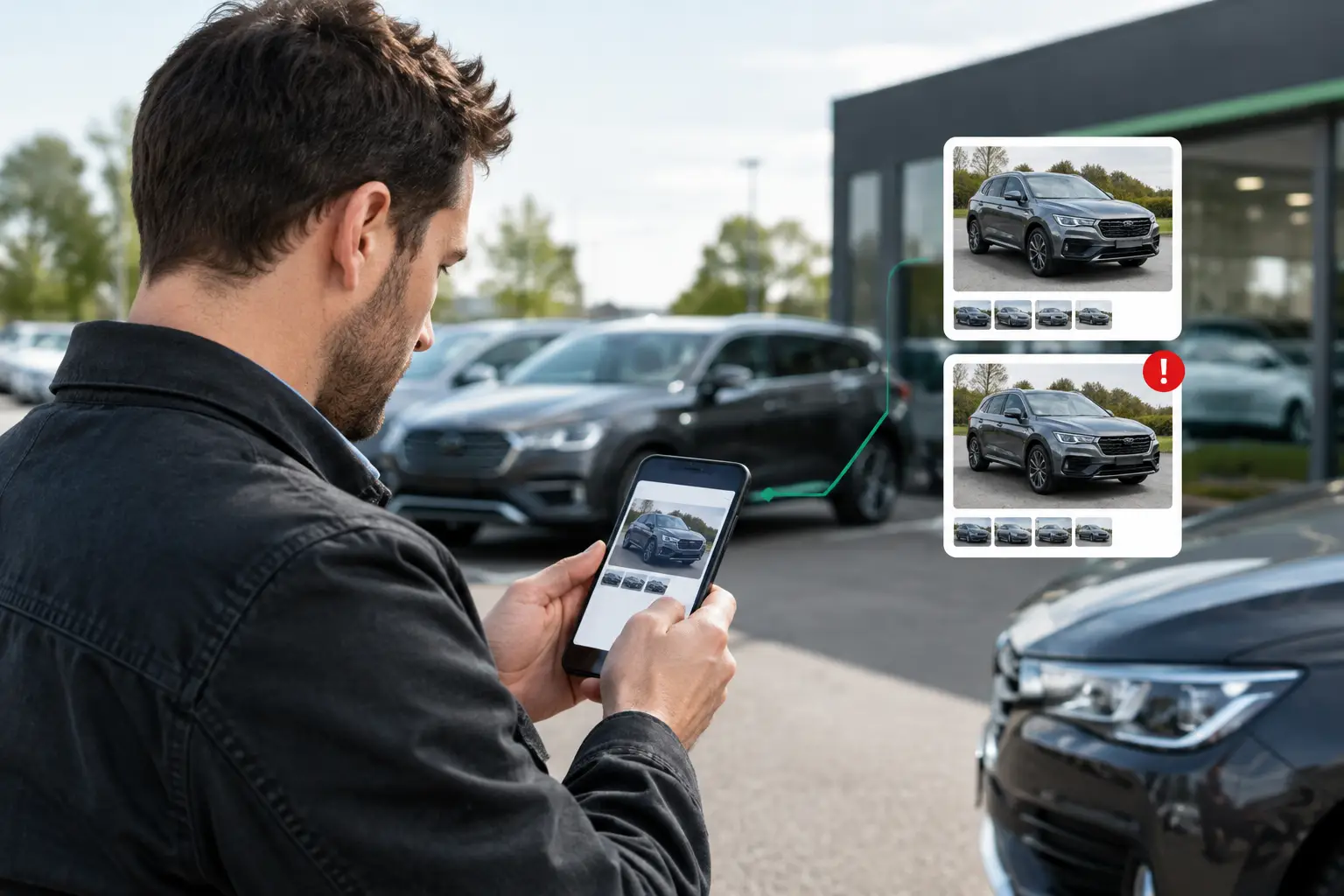
A car can look right in an advert and still be using the identity of another vehicle. To identify cloned vehicle adverts, start before you travel: compare the registration, make, model, colour, MOT record, mileage and seller’s story. If any part does not line up, pause. A warning is not an accusation, but it is a reason not to pay a deposit or hand over money.
30-second answer
A cloned vehicle is usually a stolen car made to appear legitimate by using the registration number, number plates or identity details of a similar genuine vehicle. A related risk is an advert that copies photos and details from a real listing to obtain a deposit for a car the seller does not have.
The strongest early warning is a mismatch. The advert says one thing, official MOT and mileage records suggest another, and the seller cannot give a clear explanation. Check the registration before making plans, then verify that the physical car, its paperwork and the seller all match the identity you researched.
Do not rely on a clean-looking advert, a convincing reason for a quick sale or a copy of a V5C alone. Documents, photographs and number plates can all be copied. Verification needs several pieces of evidence that agree.
What a cloned vehicle advert can look like
Not every suspicious advert is a vehicle clone. Some are deposit scams using stolen images. Others involve a genuine car advertised with incorrect details because the seller has made a mistake. The risk becomes more serious where the car presented for sale may not be the vehicle associated with its registration.
A common cloning pattern involves a stolen vehicle fitted with plates copied from a similar car - often the same make, model and colour. An online check against the registration can therefore appear plausible at first glance. That is precisely why you must compare more than the basic vehicle description.
The advert may also be priced noticeably below comparable cars, paired with a story that discourages questions: an urgent move, a family emergency, a buyer already waiting or a request to secure it immediately. Any one point can have an innocent explanation. Several points together deserve a firm stop-and-check response.
Check the advert before you travel
Begin with the registration number. A free MOT and mileage check gives you useful facts to compare with the listing: vehicle description, test dates, recorded mileages and advisory history. Check whether the advertised mileage makes sense against the recorded sequence. A gap is not proof of wrongdoing, but a lower advertised mileage than a previous reading needs resolving before you go further.
Read the MOT record for details that ought to be visible or discussed. Repeated tyre, brake, suspension or corrosion advisories do not make a car cloned. They can, however, expose an advert that claims the car has been meticulously maintained or recently passed with no issues. Ask the seller directly when work was done and request invoices where relevant.
Compare the specification closely. The year, fuel type, engine size, body style and colour should be consistent. Be particularly careful with a colour discrepancy. A legitimately colour-changed car may exist, but it requires a credible explanation and matching documentation. It is not something to wave through because the photographs are attractive.
Look at the photos as evidence, not decoration. Are the number plates blurred in every image, while the seller refuses to provide the registration privately? Are the pictures taken in different locations, seasons or countries? Does the number plate look poorly fitted, unusually new, mismatched front to rear or obscured by a plate holder? These signs are not verdicts on their own, but they justify more checks.
If the advert images appear unusually polished, search your own recent browsing history and compare them with similar listings you have seen. Scammers often reuse photos. A seller who genuinely has the vehicle should be able to provide a current photo showing a specific requested detail, such as the dashboard mileage alongside a handwritten date. Do not ask them to reveal personal information in the image.
Questions that test the seller’s story
A genuine private seller should usually be able to answer ordinary questions about a car they own. Keep your questions specific and calm. Ask how long they have owned it, why they are selling, where it was bought, where it can be viewed and whether the V5C is in their name and current address.
Then ask questions tied to the car’s history. If the MOT record shows an advisory, ask what was done. If the mileage has risen sharply or slowly between tests, ask how the car was used. If the seller avoids straightforward questions, changes the subject or presses for a deposit, treat that behaviour as part of the risk picture.
Be cautious if the seller says the car can only be viewed in a car park, motorway service area or other temporary location. There can be legitimate reasons, but a home address or established business premises gives you a more credible setting to verify ownership and paperwork. For a private sale, you should be able to see the car where it is normally kept or get a sensible explanation for why not.
At the viewing: make the identity checks count
Do not transfer a holding deposit merely to see the vehicle. Arrange to inspect it in daylight and take someone with you if possible. Your aim is not to accuse the seller. It is to confirm that the car in front of you is the one you researched.
Check that the registration plates match the advert and the registration shown on the V5C. Then locate the vehicle identification number, or VIN. Its position varies by vehicle, but it is often visible through the windscreen and may also appear on a manufacturer plate or stamped into the body. The VIN on the car should match the VIN on the V5C exactly.
Look for signs that identifiers have been disturbed. Uneven rivets, scratches around a VIN plate, mismatched fonts, loose plates or evidence of recent tampering are reasons to stop. Do not attempt to remove trim or interfere with the vehicle. If something looks wrong, walk away and consider reporting your concerns through the appropriate channel.
Check the V5C carefully. The registration, VIN, make, model and colour should match the car. The registered keeper’s name and address should fit the seller’s explanation. A V5C is not proof of legal ownership, and its presence does not remove the need for other checks. Equally, an unavailable piece of information is not a green tick. CarSussed does not turn an unknown into a green tick.
Do not let payment create pressure
Cloning and deposit fraud both rely on urgency. The seller may say several people are on the way, claim the price is valid only today or offer to deliver the car after a bank transfer. A real bargain is not made safer by moving faster.
Avoid sending money to reserve a car until you have verified the seller and vehicle to a level you are comfortable with. Never let a seller’s deadline replace your checks. If you do proceed, use a payment method that leaves a clear record, ensure the account details make sense for the person or business selling the car, and obtain a written receipt with the vehicle registration, price, date and seller details.
Be especially wary of a request to pay a different person, a newly changed bank account or cryptocurrency. These arrangements make it harder to trace what happened if the car or advert is not genuine.
Use a report to join up the evidence
A registration check is a starting point, not a substitute for seeing the car. It can reveal history indicators that affect whether you travel, what you ask and how you negotiate. Finance, theft, write-off, ownership, plate and mileage information each answer different questions, subject to the evidence available for that specific vehicle.
For a £9.99 one-off report, CarSussed turns connected history indicators, official MOT information and mileage interpretation into a practical buyer verdict: BUY, NEGOTIATE, CAUTION or WALK AWAY. It also separates returned evidence from unavailable information, so you can see where further verification is still needed before money changes hands.
That matters with suspected cloning. A report may highlight a concern worth investigating, but it cannot physically inspect a VIN, validate a document in your hand or guarantee a seller’s identity. Use the findings to focus your viewing checks, not to skip them.
When to walk away
Walk away if the VIN and V5C do not match, the seller cannot explain clear history contradictions, the address or identity changes without a credible reason, or you are pressured to pay before viewing. The same applies if the seller refuses reasonable checks or the car’s physical details do not match the identity associated with its registration.
You do not need to prove fraud before deciding not to buy. Used-car buying is a decision about risk, not a courtroom test. There will be another car, and the cost of leaving is usually far lower than the cost of inheriting a problem vehicle.
Trust the evidence that can be checked, keep your pace when a seller tries to rush it, and verify the car in front of you before any money changes hands.