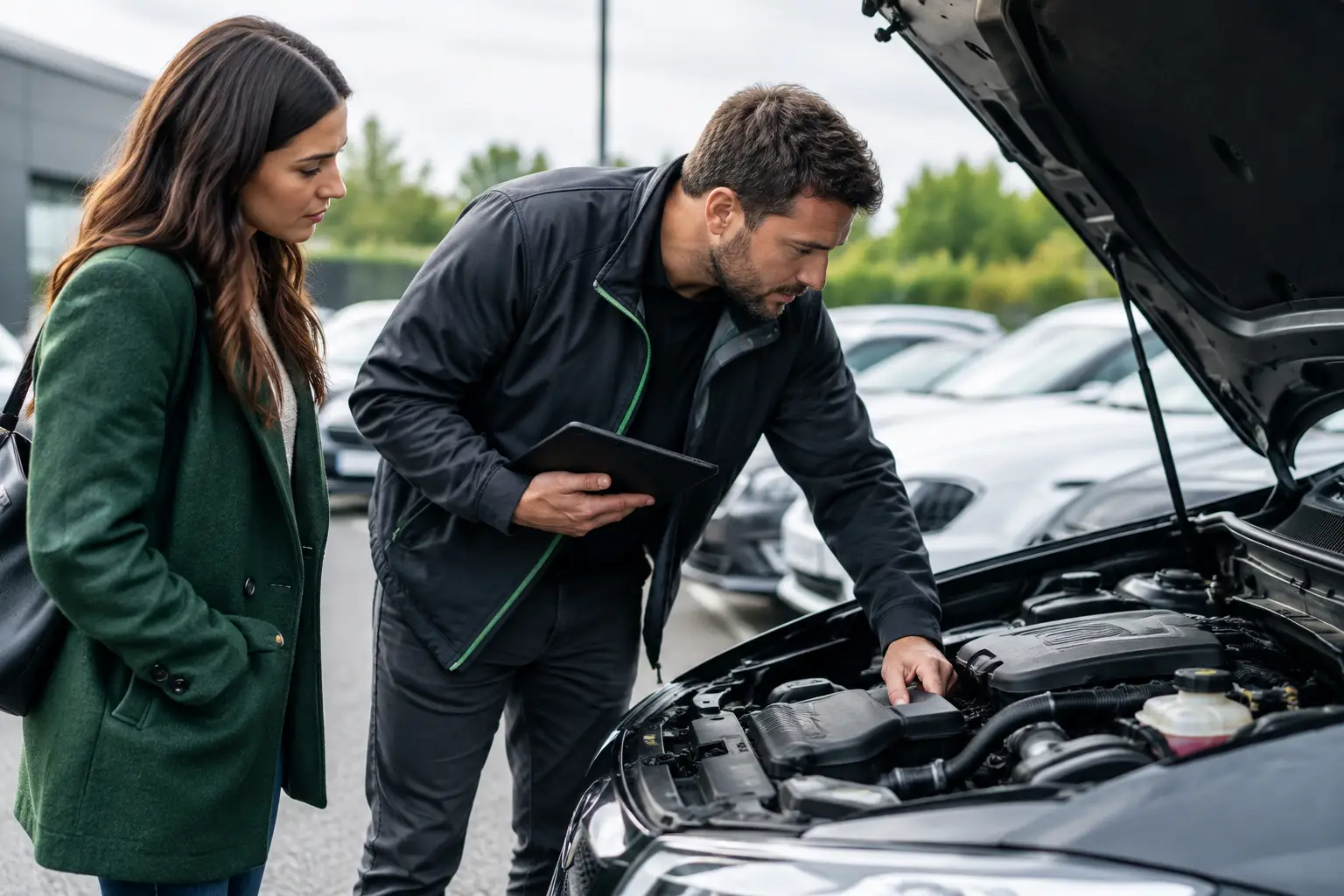
A clean advert, a fresh valet and a seller who says the car has “never missed a beat” are not safety evidence. The best used car safety checks combine a vehicle’s recorded history with a careful look, a proper test drive and a willingness to walk away when the facts do not stack up.
30-second answer
Before you travel or leave a deposit, check the registration against official MOT and mileage records, then investigate finance, theft, write-off, ownership and plate-history indicators. At the viewing, inspect tyres, lights, brakes, steering, seatbelts and warning lights. Finally, drive the car long enough to feel how it starts, stops, turns and changes gear.
A warning is not an accusation. A single MOT advisory does not automatically make a car unsafe, and a clean-looking history does not prove it has been maintained properly. What matters is the pattern, the seller’s explanation and whether the asking price reflects the risk.
Start with checks that can stop the purchase
Some problems are inconvenient. Others can leave you with a car you cannot safely use, cannot insure easily or may not legally own outright. Run the history checks before you spend a Saturday travelling across the country.
Read MOT history as a pattern, not a pass mark
An MOT pass only confirms the car met the required standard on the day of the test. It is not a promise that the car is fault-free now. Read the full history and look for repeat failures or advisories involving brakes, tyres, suspension, steering, corrosion, lights and visibility.
Repeated tyre advisories may suggest neglected maintenance or alignment problems. Recurring brake defects deserve a direct question about what was replaced and when. Corrosion warnings need particular care on older cars, especially where they mention prescribed areas, structural components or brake lines.
Check the mileage readings alongside the dates. Mileage that rises steadily is reassuring, but it is still only one piece of evidence. A discrepancy, an unexplained drop or a long gap in testing should be investigated before money changes hands.
Check the risks that a driveway inspection cannot reveal
A physical viewing cannot tell you whether a vehicle has outstanding finance, has been recorded as stolen, has a write-off record or carries a plate-history concern. These are separate questions from mechanical condition, and each can affect whether you should buy and what you should offer.
Do not treat information that is unavailable as a green tick. Data coverage can vary by source and vehicle. The sensible position is simple: confirmed information is useful; information not returned remains unknown. Ask the seller for documents where they can help fill the gap, but do not accept paperwork alone as proof that every risk has disappeared.
For a £9.99 one-off report, CarSussed combines history indicators with MOT and mileage interpretation, a buyer score and a practical verdict. The useful part is not merely seeing a flag. It is understanding whether the evidence points to BUY, NEGOTIATE, CAUTION or WALK AWAY before you commit to the journey or the price.
Best used car safety checks at the viewing
Arrive in daylight if possible, with the engine cold. A seller who has warmed the car before you arrive may have a perfectly reasonable explanation, but you lose the chance to see how it starts from cold. If they will not allow a proper inspection or test drive, do not invent a reason for them. Leave.
Check the tyres, wheels and brakes first
Tyres are one of the clearest signs of how a car has been looked after. Check for legal tread across the full width, but also look for cracking, bulges, cuts and uneven wear. Uneven wear can point to poor alignment, worn suspension parts or prior impact damage. Confirm that tyre types and sizes match across each axle, and inspect the spare wheel or inflation kit if the car is supplied with one.
Look through the wheels at the brake discs. A lip around the edge, surface corrosion or visible scoring is not always urgent, but it helps you judge likely upcoming costs. On the test drive, the car should brake in a straight line without vibration through the pedal or steering wheel. A soft pedal, pulling, grinding or a brake warning light is a reason to stop and arrange professional inspection, not a detail to negotiate away casually.
Look for signs of collision repair or structural trouble
Walk around the car slowly. Check that panel gaps are broadly even, paint colour is consistent in different light and doors, bonnet and tailgate close properly. Look for overspray on trim, mismatched lamps, fresh underseal hiding a small area, or bolts with disturbed paint around wings and bonnet hinges.
None of these signs proves a serious accident. Cars can have had cosmetic repairs that were completed well. But if the vehicle has a write-off record, visible repair clues or a seller whose story keeps changing, the risk rises. A professional inspection is often cheaper than discovering poor repair work after purchase.
Test the safety equipment, not just the radio
Switch on the ignition and watch the dashboard. Warning lights should illuminate briefly as part of the system check, then go out after the engine starts. Pay close attention to airbag, ABS, engine-management, tyre-pressure and brake warnings. A light that stays on, has been covered or does not appear at all needs an explanation and likely further diagnosis.
Test every seatbelt by pulling it sharply to make sure it locks, then check the buckle and webbing for damage. Try the horn, indicators, hazard lights, headlights, brake lights, reversing lights, wipers, washers and heated rear screen. Visibility and signalling faults can be straightforward fixes, but they are still faults - and they reveal how thoroughly the seller prepared the car.
Use the test drive to expose what a parked car hides
A five-minute loop around the block is rarely enough. Drive on roads that let you accelerate, brake, turn at low speed and cruise at a steady speed. Keep the radio off at first.
Listen for knocks over bumps, a droning wheel-bearing noise that changes with speed, clutch slip under acceleration, or a whine from the gearbox. The steering should feel controlled and the car should not wander, vibrate excessively or pull strongly to one side. For an automatic, note any harsh engagement, hesitation or flaring revs between changes. For a manual, check that the clutch engages predictably and the gears select cleanly.
Watch the temperature gauge once the engine is warm. Check for smoke from the exhaust, unusual smells, coolant warnings or signs of overheating. After the drive, look underneath for fresh leaks and check that the cooling fan or electrical systems are not behaving oddly.
Some issues only appear when a car is cold, under load or driven for longer than a viewing allows. That is why a good test drive reduces uncertainty but does not replace an independent mechanical inspection, particularly on an older, higher-mileage or higher-value vehicle.
Match the evidence to the seller’s story
Ask short, specific questions, then listen for answers that match the paperwork and the car in front of you. Why is it being sold? How long has the seller owned it? What work has been done since the last MOT? Are there invoices for servicing, tyres, brakes or repairs? Has it ever been damaged? Is every key present?
A private seller may not have a perfect folder of invoices. An independent dealer may not know every detail of an older part-exchange. That alone is not proof of dishonesty. The concern is a gap between the advert, the history, the documents and what you can see.
If MOT records show repeated suspension advisories but the seller says it has “needed nothing”, ask for evidence of the repair. If a low price is explained by “a quick sale”, consider whether the price also reflects a fault you have not yet found. Good sellers should expect sensible questions about safety and history.
Decide before emotion takes over
Write down the asking price, your maximum price and the defects or unknowns you have found before viewing. That makes it much harder for a polished advert, a long journey or fear of missing out to make the decision for you.
Choose to negotiate when faults are understood, repairable and honestly reflected in the price. Choose caution when evidence is incomplete, a history pattern needs explanation or a professional inspection could materially change the decision. Walk away when there are serious safety concerns, inconsistent mileage, unresolved ownership risks, pressure to pay quickly or a seller who blocks reasonable checks.
The right used car is not the one that looks perfect on the driveway. It is the one whose evidence, condition and price still make sense when you are ready to transfer the money.